CFE Group
Client
Belgium, Europe
Brussels' ZIN Project: The European benchmark for circularity in construction
January 2023 - August 2025 · Construction & Building materials, Consumer products · The Netherlands, Europe
The plastics industry faces growing pressure to move beyond recycling claims and demonstrate real circularity. For Berdal, a Dutch manufacturer of plastic and rubber products for a product frequently used in the construction industry, the question was not whether to act on that pressure, but how to do it credibly.
In this article, you will learn how Berdal shaped circular products with the Cradle to Cradle Certified® program, unlocking full supply chain transparency, and laid the foundation for a closed-loop plastics system.
Berdal is a family-owned House of Brands based in Almelo, the Netherlands, with over 50 years of experience in manufacturing construction products. Their portfolio spans multiple brands, distributed through major retailers and professional channels across Europe. Sustainability has long been part of their identity: recycled raw materials, energy-efficient production, and plastic-free packaging.
Their Gripline range of buckets and tubs was already made from post-consumer recycled plastic. But in the plastics industry, claiming circularity and proving it are two very different things. Making credible claims requires verified data and following an recognized scientific standard to proof your product is truly circular (and not just saying it is).
Berdal had been working with recycled materials for years, but the Blue Angel certification did not go far enough on product-level circularity. They wanted a framework that went beyond what the market expected and avoided the risk of greenwashing in terms of circularity claims.
Besides, it was clear for Berdal that their ambition was to improve their sustainability performance by focusing on circularity. One of their key strategies was (and still is) focusing on materials. Their Gripline buckets & tubs, made from post-consumer plastic waste, were already fit for cycling. Their production process already allowed for the recycling of the returned products, granulating these with a partner organisation, and turning these back into buckets and tubs.
When looking for a rigorous, independent certification to verify every step of their circular ambitions, they found out about the Cradle to Cradle Certified® Products Program. Berdal brought Sustenuto on board to guide and support them towards certification.
To get Cradle to Cradle Certified®, companies must go far beyond surface-level sustainability claims. It requires a deep understanding of every material used, full transparency across the supply chain, verification of chemical safety, and a clear plan for what happens to a product at the end of its life. In other words, you need to know exactly what your product is made of, where it comes from, and where it will go next.
With this in mind, the starting point was to support Berdal in uncovering what is often one of the most complex challenges in plastics: the supply chain. What had been a black box became fully documented, transparent and a traceable system. In an industry where materials pass through multiple parties, making verification difficult, this level of clarity is rare. This level of insight is essential to monitor the toxicity of the product, provide evidence of the material's origin and understand the circularity potential of the product after use.
Transparency also brings hidden risks to the surface, which happened during the material health assessment. One of the criteria is to ensure safe and circular materials, as these are essential in a circular economy because they ensure that products can be reused, recycled, and remanufactured without continuous exposure to harmful substances, enabling truly sustainable and continuous material loops. The materials are therefore screened against strict criteria in line with leading chemical regulations and an organohalogen screening.
Post-consumer recycled content has an increased risk of being contaminated. For example, a mix of plastics with an unknown chemical composition or a battery ending up in the recycling process unintended. The methods and control measures at recyclers are therefore key to ensuring safe materials that are fit for a circular economy. Hence, it is only logical that certification requires analyte testing for hazardous substances.
During testing, Sustenuto identified unexpected contamination in the recycled granulate. Tracing it back revealed the source: medical packaging entering the recycler’s input stream, something standard quality checks had missed.
Rather than stopping at identification, Sustenuto worked closely with Berdal and the recycler to eliminate the issue at its source. The result was not only a cleaner material stream, but also verified proof that the recycled content is chemically safe, turning a hidden risk into a competitive strength.
Certification does not stop at safer materials or transparent supply chains. It also demands a credible vision for the future. It demands a concrete plan for how the product re-enters the loop at end-of-life, not just recycled input.
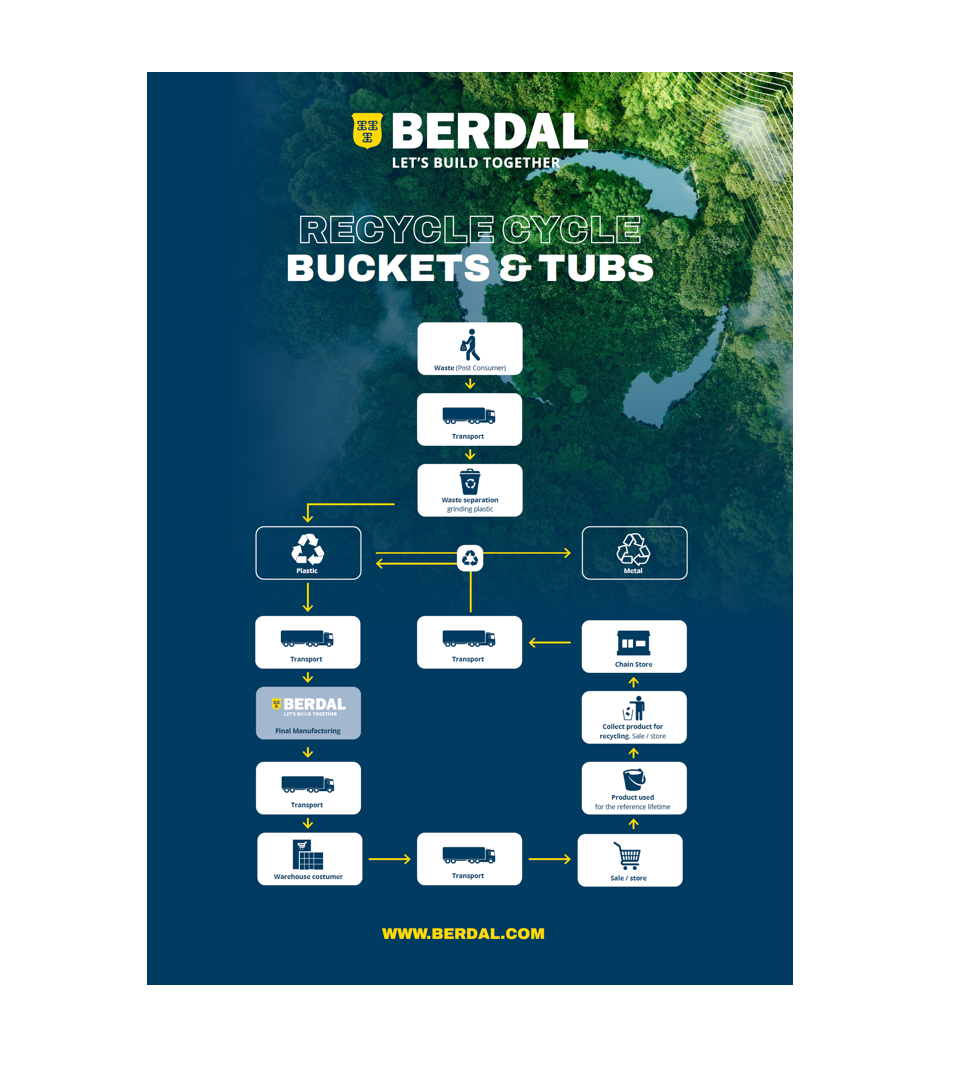
With Sustenuto guiding the process, Berdal developed an ambitious Circularity Plan for the Gripline range. The goal is a fully closed loop: the same plastic waste type products that enter production are recovered after use and fed back in.
Their product circularity plan covered:
Mapping take-back and collection partners across the Netherlands and Germany
Creating clear end-user guidance on which plastics can re-enter the cycle
Structuring the data as a foundation for future collection pilots
While the infrastructure to achieve this at scale is still evolving, the foundation to create a circular infrastructure for their product is in place, with a clear roadmap, aligned partners, and the data to make it work. This circular roadmap has helped Berdal determine its actions and concrete steps to get to the next phase: a pilot. It is an ambitious plan in line with their mission in circularity, closing the loop and becoming an industry leader.
With the help of Sustenuto, Berdal emerged as one of the few plastics manufacturers in the construction industry that can back up their circularity claims with hard evidence. Although the main intention was to get certified, the process has delivered multiple outcomes with one and the same effort:
Verified circularity data. Gripline products can claim 95 to 100% post-consumer recycled content, verified through chain-of-custody documentation. This is industry-leading performance for a plastics product. The circularity data and cycling instructions are publicly available and can be downloaded via this link.
The use of safer materials. By identifying and tracing the contamination source in Berdal’s supply chain, it enabled them to collaborate with the recycler to phase it out. Berdal now sources a safer granulate with test results as evidence.
Full supply chain transparency. By getting full insight into the supply chain, Berdal is able to monitor and control the material flows from waste to finished product: a compliance asset and a strategic tool for better sourcing decisions.
Data relevant for ISO 14001 . The data gathered through Cradle to Cradle Certified® directly contributed to Berdal's ISO 14001 certification. One process, but data for two certifications.
A Circularity Plan as a foundation for action. Berdal enters the next phase with a certified, structured plan for closing the loop: clear on the infrastructure gaps, the partners needed, and the path to a working take-back system.
Circularity does not stop after certification. It helped Berdal develop a post-certification roadmap for further improvements. In fact, the Circularity Plan developed with Sustenuto revealed a key insight: the technical loop is already in place. Berdal can process returned material straight back into new Gripline products. However, the bottleneck is collection, not production. Scaling requires the full supply chain: retailers, distributors, construction companies, and logistics partners.
Berdal is now working with partners to build that collection infrastructure, starting small and scaling from there. The focus is on the right entry points, not activating every player at once.
Berdal came to Sustenuto to go beyond a recycling claim, but left with not only a certificate, but also verified data, a more chemically safe material, full supply chain transparency, and a credible roadmap for a genuinely closed-loop plastics product.
Ready to take your product circularity beyond the claim? Get in touch with our team.
CFE Group
Client
Belgium, Europe
The LYCRA Company
Client
Worldwide, Europe, United Kingdom, The Netherlands, Portugal

PetStar
Client
Worldwide, North America, Mexico