


During Circular Economy Week in the Netherlands, we brought together a group of R&D professionals, managing directors, sustainability managers and product designers to really get to grips with circular, safe and healthy product design in line with the principles of internationally recognised standards.
From theory to practice
The workshop took place at our office in Utrecht. The Utrecht Community (UCO), a former Dutch Railways (NS) train depot, which is nowadays an example of circular thinking in practice: sustainably renovated and used by a community of entrepreneurs all working in the field of sustainability. The venue, featuring abundant greenery and wood accents, provides an uplifting and distinguished atmosphere upon entry.
We started with a plenary on the circular economy, discussed the importance of verified product data for circular design, and reviewed workshop expectations. The participants outlined several key expectations: understanding the relationship between certification and product design, identifying strategies for initiating certification when the product is already developed, and clarifying the scope of R&D team activities.
Those expectations were exactly what we wanted to address.
Why is data so important for circular products?
Only 7% of the global economy is currently circular, and that percentage is barely growing. At the same time, research into product life cycles shows that by far the greatest environmental impact is already determined in the design phase: which materials do you choose, how do you assemble the product, and what do you consider for the end of the use phase? Nienke Steen of the Cradle to Cradle Product Innovation Institute pointed out that an estimated 45% of emissions are caused by the way we manufacture products and use them. It is estimated that 80% of the environmental impact is determined by a product’s design.
Creating products that fit into a circular economy is therefore not a matter of waste management. It starts with product design, material choices, suppliers, the chemical composition of materials, and perhaps even that single component contained within. Circular product design is therefore not a waste issue. It is an R&D issue.
Pressure is also mounting from the EU: extended producer responsibility is becoming more widespread, the Ecodesign for Sustainable Products Regulation (ESPR) sets minimum requirements per product category, and the mandatory digital product passport is on the way. The effective date of the regulations differs by product category and is being implemented in phases. However, we can say with certainty that organisations investing in circular product data now will be better prepared for the upcoming regulations. Collecting (verified) data takes time.
Another reason is AI and how this is rapidly changing purchasing decisions, especially when it comes to sustainability. As AI systems become more embedded in procurement processes, digital marketplaces, and consumer tools, they increasingly rely on structured, verifiable data to compare products. This means that claims alone are no longer enough; what matters is whether sustainability information can be trusted, validated, and consistently interpreted by machines.
In this context, verified data becomes more valuable than ever. Products supported by independently verified information, such as third-party certifications, standardized metrics, and transparent reporting, are more likely to be recognised and recommended by AI-driven systems. This shifts the competitive advantage toward companies that can provide credible, data-backed evidence of their environmental and social performance.
As a result, aligning with international frameworks and standards is no longer just a compliance exercise; it becomes a strategic necessity. Frameworks such as Cradle to Cradle Products Innovation Program and ISO 59000 series provide the structure and comparability that AI systems depend on.
So in short, whether your company chooses to do so because of the new EU rules or to make strategic choices, circular product data is crucial. Without that data, circularity remains a good intention rather than a strategic choice that enables you to meet the requirements.
ISO 59000 and Cradle to Cradle: a framework for practice
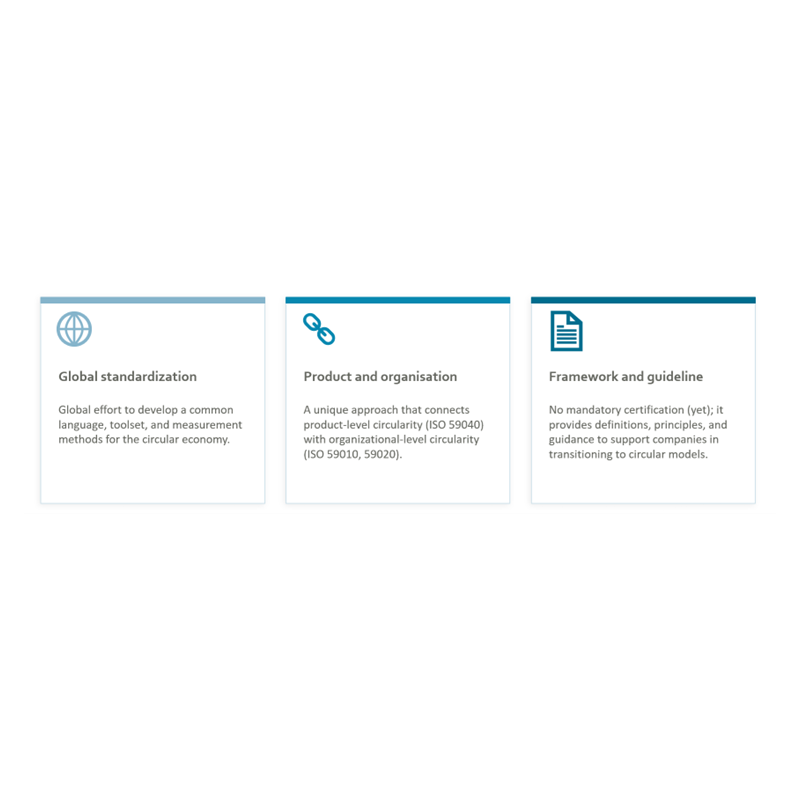
The workshop was aligned with two internationally recognised frameworks for the circular economy: the ISO 59000 series as the normative basis for the circular economy, and the Cradle to Cradle Certified® Products Innovation Programme as one of the most ambitious certification standards for circular products.
The ISO 59000 series establishes terminology, principles and measurement methods for the circular economy. The ISO series guides defining and demonstrating circularity, including in the context of EU reporting and product passports.
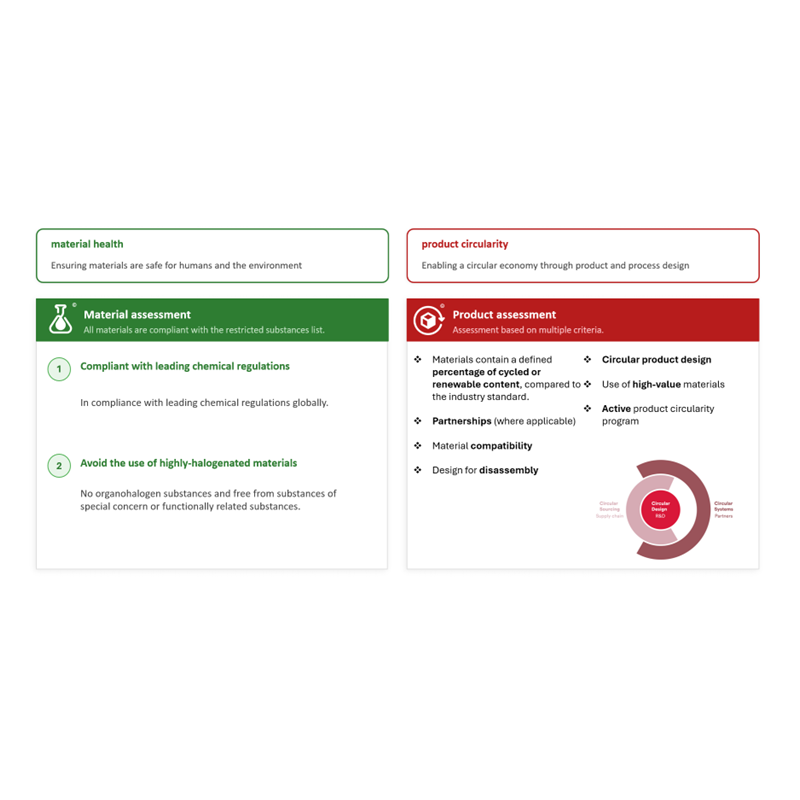
The Cradle to Cradle Certified® Products Innovation program (a third-party verified certificate) assesses products across five categories: Material Health, Product Circularity, Water & Soil Stewardship, Clean Air & Climate Protection, and Social Fairness. The workshop deliberately focused on the first two: the categories over which R&D and product developers have the most direct influence.
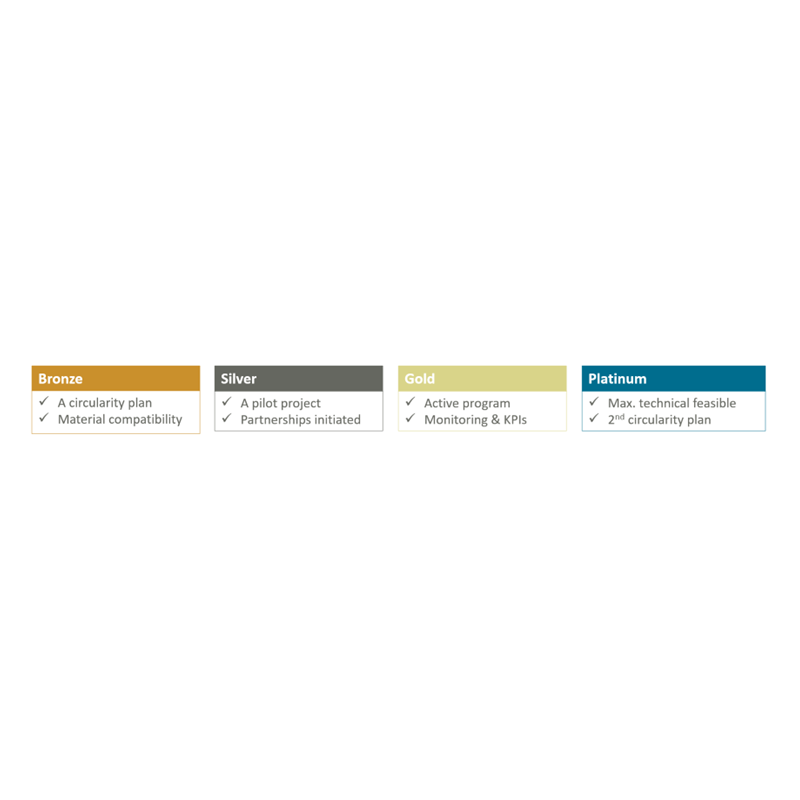
Within the certification process, you can achieve different levels. For the product circularity category, the following criteria broadly apply.
Bronze: There is an initial plan, including a first material assessment, to determine whether the product and materials are suitable for the chosen plan.
Silver: There is a pilot phase with active partnerships to set up the circular infrastructure.
Gold: The product is actively circulating, and there is active monitoring in line with the objectives.
Platinum: The product is circular to the maximum extent technically feasible, with a plan also drawn up for multiple circularity strategies per product.
Material Health: choosing safe and healthy materials
The workshop challenged participants to conduct a brief investigation into various materials. Participants investigated the toxic risks of materials by assessing available information, particularly gaps in this information, and identified risks per material type (virgin raw material, bio-based or post-consumer recycled material). This highlights that testing post-consumer recycled material for toxicity is crucial. It also shows that bio-based materials carry risks relating to pesticide use. In addition, there are certain materials that we know do not fit into a circular economy or require extra attention (for example, PVC). This formed a first step towards a better understanding of the approach.
The practical value: these assessments translate directly into action. Which materials or substances need to be replaced? Which suppliers need to be more transparent about the chemical composition of materials? That is the moment when theory becomes a working method within an organisation.
Product Circularity: choosing and developing a circular strategy
In the workshop, participants set to work on choosing a circular strategy. The task: determine a circular strategy depending on the biological or technical cycle into which the product enters after the end-of-use phase. Identify which partners are needed for this and consider the infrastructure required.
The participants grappled with questions that are genuinely relevant in practice: what if a construction product is always made to different dimensions, then how do you organise reuse? Who is responsible once a product enters the chosen circular infrastructure? And how does material selection relate to the circular strategy you are aiming for?
The conclusion that kept coming up: you cannot view the circular endpoint in isolation from the initial material choices made in the design phase. Designing for circularity starts at the drawing board, not at the waste processor.
The digital product passport (DPP): starting now to collect circular data makes all the difference
In the final part, we linked the workshop to the digital product passport that is coming our way from the EU. This passport requires precisely the information that participants had collected: material composition, circularity, partners, chemical content and toxicity risks. For organisations already working with this approach, the passport is only a logical next step.
The experience of participants in the ‘Safe & Circular by Design’ workshop
In brief, we’ll share the five concrete steps for circular product design that we discussed during our workshop:
Baseline assessment: know what’s in your product
Choose safe and healthy materials, including when working with recycled materials
Choose a circular strategy that aligns with your material choices
Collaborate with partners and demand transparency to create circular infrastructures
Use standards and certifications as an approach and recognised method
This two-hour workshop combined strategy, technical depth and practical tools to develop products that are safe, circular and future-proof, and that comply with international standards.
Read participants’ experiences below
“Fascinating workshop! The exercises really make you think for yourself. You end up re-examining data and processing methods.”
“Really enjoyable workshop. Good overview and practical guidance.”
“Really nice! A new perspective on material use and how to link it to the R-strategies.”
“Enjoyable workshop. A good mix of information and practical exercises.”
Would you like to know more about our circular product design workshop?
We also deliver the workshop in-house or in collaboration with other organisations. We tailor the workshop to your products, knowledge level and any specific issues. The workshop ranges from a 2-hour introductory session to an in-depth day with practical exercises based on your own products. Please contact us for more information.
